
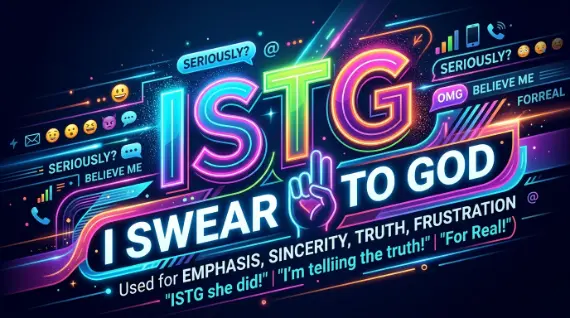
If you’ve seen “ISTG” in a text, comment, or social media post, it usually means “I swear to God.”
People use ISTG to emphasize what they are saying, show that they are serious, insist that something is true, or express strong emotions such as frustration, surprise, excitement, or disbelief.
For example:
“ISTG, I didn’t take your charger.”
This means something like:
“I swear I didn’t take your charger.”
The exact tone depends on the situation. ISTG can sound completely serious, mildly annoyed, dramatic, or even playful between friends.
What Does ISTG Meaning in Text?
ISTG = I swear to God.
It is an informal internet initialism used in texting and online conversations. In many cases, it works like “I swear,” “I promise,” “seriously,” “believe me,” or “I really mean it.”
For example:
- “ISTG I saw him at the mall.” → I swear I saw him at the mall.
- “ISTG this phone never works.” → Seriously, this phone never works.
- “ISTG you’re making me laugh.” → I swear, you’re making me laugh.
- “ISTG I thought today was Saturday.” → I seriously thought today was Saturday.
The abbreviation itself stays the same, but the emotion behind it can change.
What Does ISTG Meaning in Text Stand For?
The four letters represent:
| Letter | Word |
|---|---|
| I | I |
| S | Swear |
| T | To |
| G | God |
So, ISTG means “I swear to God.”
It is an initialism because the letters represent the initial letters of the words in the phrase. You may see it written as ISTG, istg, or Istg. Capitalization usually does not change the meaning.
Dictionaries and language references describe ISTG as an internet/texting abbreviation for “I swear to God.”
What Does ISTG Meaning in Text in Different Contexts?
ISTG is more about emphasis and emotion than one specific emotion. Context tells you how the sender intends it.
1. ISTG Can Show Honesty
Someone may use ISTG when they want you to believe that they are telling the truth.
Example:
“ISTG, I didn’t delete your message.”
Meaning:
“I swear I didn’t delete your message.”
Here, ISTG strengthens the person’s claim.
2. ISTG Can Express Frustration
It is also common when someone is annoyed by a situation.
Example:
“ISTG, this computer freezes every five minutes.”
Here, the person isn’t necessarily making a literal oath. They are emphasizing how frustrated they are.
3. ISTG Can Show Surprise
Sometimes ISTG introduces an exaggerated reaction to something unexpected.
Example:
“ISTG, that was the funniest thing I’ve ever seen.”
In this case, ISTG adds emotional intensity to the statement.
4. ISTG Can Be Playful
Friends may use ISTG jokingly without intending the phrase as a serious oath.
Example:
“ISTG, you have the worst luck 😂”
The laughing emoji and friendly context make the message sound playful rather than angry.
5. ISTG Can Emphasize a Promise
It can also make a promise or assurance sound stronger.
Example:
“ISTG I’ll be there at 8.”
This roughly means:
“I swear I’ll be there at 8.”
Whether the person is making a serious promise or simply emphasizing their intention depends on the conversation.
Does ISTG Always Mean Someone Is Angry?
No.
This is one of the easiest ways to misunderstand ISTG.
The abbreviation can sound:
- Serious
- Frustrated
- Annoyed
- Sincere
- Surprised
- Excited
- Dramatic
- Playful
- Humorous
Compare these two messages:
“ISTG, stop doing that.”
This could sound irritated or like a warning.
But:
“ISTG 😂 you’re so funny.”
is much more likely to be playful.
So, don’t interpret ISTG by itself. Look at the words around it, punctuation, emojis, and the relationship between the people talking.
ISTG Meaning in Text: Serious vs. Casual Use
The original phrase “I swear to God” can be used as a strong assertion or oath. Online, however, ISTG is often much more casual.
Someone might write:
“ISTG my cat knows when I’m busy.”
They probably aren’t making a formal religious oath. They are simply adding emphasis to a humorous observation.
This distinction is important because online slang often preserves the emotional force of a phrase while making it much more casual.
ISTG Meaning in Text Examples in Messages
Here are some realistic examples showing how the meaning can change with context:
| Text | What ISTG is expressing |
|---|---|
| “ISTG, I didn’t touch it.” | Sincerity / insisting |
| “ISTG this traffic is horrible.” | Frustration |
| “ISTG that movie was amazing.” | Strong enthusiasm |
| “ISTG 😂 you always do this.” | Playful annoyance |
| “ISTG I thought you were coming.” | Surprise or frustration |
| “ISTG I’ll call you tonight.” | Promise / assurance |
| “ISTG, that’s the same guy from yesterday.” | Strong insistence |
| “ISTG 😭 I can’t stop laughing.” | Dramatic or humorous emotion |
The safest interpretation is usually “the sender strongly wants to emphasize what comes next.”
How to Understand ISTG Meaning in Text Conversation
If you’re unsure what someone means by ISTG, use the rest of the message as your clue.
Look at the sentence
“ISTG I didn’t do it.”
The likely meaning is “I swear I didn’t do it.”
Look at the punctuation
“ISTG!!!”
Multiple exclamation marks can make the message feel more emotional or intense.
Look at emojis
“ISTG 😂”
The laughing emoji may signal that the statement is playful.
“ISTG 😭”
The crying emoji may indicate exaggerated frustration, amusement, or emotional reaction rather than literal sadness.
Look at the relationship
A close friend may use ISTG casually and jokingly. The same wording from someone you’re arguing with could sound much more serious.
Context is more important than the four letters themselves.
Is ISTG Meaning in Text a Bad Word?
Not exactly.
ISTG is not generally considered profanity, but it contains the word “God” and refers to a form of swearing or oath. Some people may avoid it for religious or personal reasons.
That means its appropriateness can depend on the person and setting.
In a casual conversation with friends, it may be perfectly normal. In a professional email, formal report, academic assignment, or workplace communication, it is better to write your meaning directly instead.
For example, instead of:
“ISTG I sent the file yesterday.”
A professional message could say:
“I can confirm that I sent the file yesterday.”
Can You Use ISTG Meaning in Text in Formal Writing?
Generally, no.
ISTG belongs to informal digital communication. It is appropriate mainly for casual texts, DMs, comments, and conversations with people who understand internet slang.
Avoid it in:
- Formal emails
- Business documents
- Academic writing
- Job applications
- Professional reports
- Official communication
Using the complete phrase or a more neutral expression is usually better in formal situations.
ISTG Meaning in Text on TikTok, Instagram, Snapchat, and Other Social Media
The basic meaning of ISTG generally remains “I swear to God” across social platforms.
You might see it in:
TikTok comments:
“ISTG this is the funniest video 😂”
Instagram DMs:
“ISTG I was about to text you.”
Snapchat:
“ISTG where did my phone go?”
Group chats:
“ISTG you guys never listen.”
The platform usually does not create a new meaning for ISTG. Instead, the surrounding conversation determines the tone.
ISTG vs. “I Swear”
ISTG and “I swear” are very similar.
For example:
“ISTG I didn’t know.”
and
“I swear I didn’t know.”
communicate essentially the same idea.
The difference is mainly style. ISTG feels more like texting or internet slang, while “I swear” works naturally in both speech and writing.
ISTG vs. ONG
You may also see ONG, which commonly means “on God.”
Both expressions can be used to emphasize sincerity or strongly support what someone is saying.
For example:
“ISTG I’m telling the truth.”
and
“ONG I’m telling the truth.”
can communicate a similar idea.
However, they are not literally the same phrase. ISTG expands to “I swear to God,” while ONG expands to “on God.”
How Do You Respond to ISTG Meaning in Text?
There isn’t one required response. Your reply should match the situation.
If someone is insisting they are telling the truth, you could say:
“Okay, I believe you.”
If they’re frustrated:
“Yeah, I get you.”
If they’re joking:
“😂 I know!”
If they’re making a promise:
“Alright, I’ll hold you to that.”
You can also simply continue the conversation normally. ISTG does not require a special response.
Where Did ISTG Come From?
The phrase “I swear to God” is much older than texting and social media. ISTG is simply its shortened internet form.
Documented online usage goes back at least to 2003, when an example of “ISTG” appeared in a Usenet discussion. Later examples and slang references helped establish it as an internet/texting initialism.
Because internet slang develops informally, it is difficult to assign one exact invention date to the abbreviation. It is safer to say that ISTG was already being used online in the early 2000s, rather than claiming a specific person invented it.
Is ISTG a Religious Expression?
The phrase literally contains a reference to God, but ISTG is not necessarily being used as a religious statement in casual texting.
For many users, it simply adds emphasis:
“ISTG this pizza is incredible.”
The sender may simply mean:
“This pizza is seriously incredible.”
However, because people have different beliefs and attitudes toward religious language, it is worth remembering that not everyone will interpret the phrase the same way.
How Can You Tell What ISTG Means?
When you see ISTG, ask yourself three simple questions:
- What comes after ISTG?
- What is happening in the conversation?
- Does the sender sound serious, annoyed, excited, or joking?
For example:
“ISTG I left my keys here.”
Likely meaning: “I swear I left my keys here.”
But:
“ISTG 😂 this cat is ridiculous.”
Likely meaning: “Seriously, this cat is ridiculous,” said humorously.
The abbreviation has the same basic definition in both messages, but its tone changes with context.
FAQs:
What does ISTG mean in text?
ISTG means “I swear to God.” It is an informal texting abbreviation used to emphasize a statement, show sincerity, express frustration, or add emotional intensity.
What does ISTG mean in texting slang?
In texting slang, ISTG usually means “I swear to God.” Depending on context, it can function like “I swear,” “I promise,” “seriously,” or “believe me.”
Does ISTG mean “I swear to God”?
Yes. ISTG is the initialism for “I swear to God.” This is the standard meaning in texting and internet slang.
Does ISTG mean someone is angry?
Not necessarily. ISTG can express sincerity, frustration, excitement, surprise, humor, or strong emphasis. You need to consider the surrounding message.
Is ISTG rude?
It can sound strong or intense, but it is not automatically rude. The tone depends on the context and relationship between the people communicating.
Can I use ISTG with friends?
Yes. ISTG is primarily an informal expression, so it can fit naturally in casual texts, group chats, DMs, and social media conversations.
Can ISTG be used professionally?
It is generally better to avoid ISTG in professional communication. Use a clearer expression such as “I can confirm,” “I assure you,” “seriously,” or “I promise,” depending on what you mean.
What is the difference between ISTG and ONG?
ISTG means “I swear to God,” while ONG generally means “on God.” Both can emphasize sincerity, but they are different expressions.
Does lowercase “istg” mean something different from “ISTG”?
No. ISTG, istg, and Istg generally have the same meaning. Capitalization is usually just a matter of typing style.
Conclusion:
ISTG means “I swear to God” in text and internet slang.
Most people use it to emphasize what they are saying, insist that something is true, express frustration, or add strong emotion. It does not automatically mean the person is angry, and it does not always represent a literal religious oath.
The best way to understand ISTG is to read it together with the rest of the message. In casual conversations, it can mean anything from “I promise” to “seriously” or “believe me,” depending on the tone.
So if someone texts:
“ISTG, I wasn’t lying 😂”
they are probably saying:
“I swear, I wasn’t lying.”
The four letters are simple, the context tells you the feeling behind them.

Hi, I’m Alex Martin, the voice behind PunsPlace.com, where words meet curiosity, clarity, and a little fun.
I love exploring the meaning, usage, and fascinating stories behind words and phrases that people encounter every day.
My goal is simple: make confusing words easier, interesting topics clearer, and every answer worth reading.
At PunsPlace, I create reader-friendly content that cuts through the confusion and gets straight to what matters.
I believe great writing doesn’t need to be complicated—it needs to be useful, natural, and memorable.
Whether you’re here to understand a tricky phrase, discover a word’s meaning, or simply learn something new, I’m glad you’re here.
Welcome to PunsPlace.com—let’s make words make sense.