
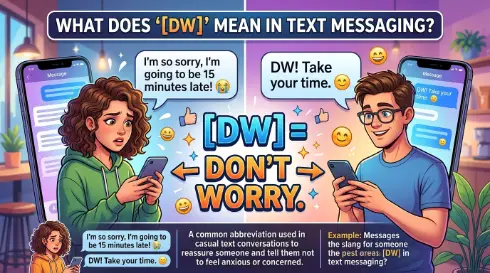
If you see “DW” in a text message, it usually means “don’t worry.” It is a casual abbreviation people use to reassure someone, respond to an apology, calm a concern, or let them know that something is not a big deal.
For example:
“Sorry I forgot to call you.”
“DW, it’s okay.”
Here, DW = don’t worry.
You may see dw, DW, or occasionally Dw in texts, DMs, group chats, and other informal online conversations. The capitalization usually does not change the meaning.
While “don’t worry” is the normal interpretation in everyday texting, context still matters. In some settings, DW can have another meaning, such as “dear wife” or “darling wife.”
What Does DW Meaning in Text?
DW most commonly means “don’t worry.”
It is an informal texting abbreviation used to make a message shorter and quicker. Depending on the conversation, it can communicate ideas such as:
- Don’t worry about it.
- It’s okay.
- No problem.
- Don’t stress.
- Everything is fine.
- You don’t need to apologize.
- I’ve got it handled.
For example:
“I’m sorry I’m running late.”
“DW, take your time.”
The person using “DW” is reassuring the other person that being late is not a serious problem.
Another example:
“I think I sent the wrong file.”
“DW, I have the right one.”
Here, “DW” means there is no reason to worry because the situation is already under control.
Is DW Meaning in Text Slang or an Abbreviation?
DW is more accurately described as an informal abbreviation or texting initialism. It is often casually called “slang” because it belongs to informal internet and texting language.
The distinction is useful, but you do not need to worry about the terminology when interpreting a message.
In everyday conversation:
DW = Don’t worry
It is generally appropriate for casual communication rather than formal writing.
For example, texting a friend:
“DW, I’ll handle it.”
But in a formal email, you would normally write:
“Please don’t worry about it. I’ll handle it.”
The full phrase sounds more professional and clearer to a wider audience.
How Is DW Meaning in Text Used in Messages?
People commonly use DW when they want to reassure someone.
1. After an apology
Someone apologizes for a small mistake, and the other person uses DW to show that they are not upset.
“Sorry I forgot your charger.”
“DW, I can get it tomorrow.”
2. When someone is worried
DW can tell another person that a situation is under control.
“I’m worried I’m going to miss the deadline.”
“DW, you still have plenty of time.”
3. When accepting a minor inconvenience
“Sorry, I can’t come tonight.”
“DW, we can meet another day.”
Here, DW makes the response sound relaxed and forgiving.
4. When offering reassurance
“I think I made a mistake on the form.”
“DW, we can fix it.”
The phrase does not necessarily mean that there is literally nothing to worry about. It can simply mean that the sender does not want the other person to stress over the situation.
What Does DW Meaning in Text Chat?
In a chat, DW usually has the same meaning: “don’t worry.”
The exact feeling behind it can depend on the surrounding messages.
Compare these:
“DW 😊”
This may feel warm and reassuring.
“dw lol”
This can feel very casual.
“DW, I already handled it.”
This sounds more confident and practical.
“dw.”
A very short reply may still mean “don’t worry,” but without additional context it can sometimes feel more abrupt or dismissive.
That does not mean DW itself has changed meaning. Tone comes from the entire message, the relationship between the people, and the situation.
What Does DW Meaning in Text on Social Media?
On social media and messaging platforms, DW generally means “don’t worry” when it appears in an ordinary conversation.
You might encounter it in:
- Instagram DMs
- Snapchat chats
- TikTok comments
- WhatsApp messages
- Discord conversations
- Group chats
- Gaming chats
- Ordinary SMS or text messages
The platform usually does not change the basic meaning.
For example:
“Sorry for sending so many messages 😭”
“DW 😂”
The second person is saying that the messages are not a problem.
Similarly:
“I thought I missed the event.”
“DW, it starts later.”
Again, DW means “don’t worry.”
The important clue is the surrounding conversation rather than the specific app.
DW Meaning in Text in Different Situations
| Situation | Likely meaning of DW | Example |
|---|---|---|
| Someone apologizes | Don’t worry | “Sorry I’m late.” → “DW!” |
| Someone is stressed | Don’t worry / don’t stress | “I might mess this up.” → “DW, you’ve got this.” |
| A small mistake happens | It’s okay | “I forgot to attach it.” → “DW.” |
| A plan changes | No problem | “Can we meet tomorrow?” → “DW.” |
| Someone asks for reassurance | Everything is okay | “Are you mad?” → “DW, we’re good.” |
| Relationship/forum context | Possibly dear/darling wife | Depends on the surrounding context |
The first meaning is by far the most relevant for ordinary texting. Oxford lists “dear wife” and “darling wife” as additional informal meanings in text and social-media contexts, so the surrounding conversation matters when DW appears outside a normal reassurance exchange.
Does DW Always Mean “Don’t Worry”?
No, but that is the meaning you would normally consider first in casual texting.
Context can change the interpretation.
For example:
“Sorry I broke your mug.”
“DW, it was an old one.”
“Don’t worry” clearly fits.
But imagine someone writes:
“My DW is coming with me.”
If the conversation is about a spouse or family, “dear wife” or “darling wife” could be intended instead. Oxford specifically records both of those meanings.
There are also contexts outside ordinary texting where the same letters can represent completely different terms. For example, technical, business, medical, scientific, or organizational contexts may use abbreviations that have nothing to do with “don’t worry.”
Therefore, do not interpret DW from the letters alone when the surrounding subject suggests a specialized meaning.
How Can You Tell Which Meaning of DW Is Intended?
Look at the words immediately before and after DW.
If someone is apologizing
“Sorry I forgot.”
“DW.”
It almost certainly means “don’t worry.”
If someone is expressing concern
“I’m nervous about tomorrow.”
“DW, it’ll be okay.”
Again, it means “don’t worry.”
If DW describes a person
“My DW and I went out.”
The meaning could be “dear wife” or “darling wife,” depending on the community and context.
If the conversation is technical
If DW appears in a workplace, academic, medical, or technical discussion, check the subject before assuming it means “don’t worry.”
Context is the best way to resolve abbreviation ambiguity.
What Tone Does DW Meaning in Text Have?
The tone of DW is usually casual and reassuring.
It can communicate friendliness, comfort, or reassurance without requiring a long response.
However, the tone can vary.
Friendly
“DW 😊 I understand.”
This feels warm.
Casual
“dw lol”
This sounds relaxed and informal.
Reassuring
“DW, I’ve got it.”
This tells the other person that the sender is handling the situation.
Potentially abrupt
“DW.”
A one-word response can sometimes feel short or dismissive, especially if the other person is discussing something serious.
This is why you should consider the whole conversation rather than assigning a fixed emotional meaning to DW.
Can You Use DW With Friends?
Yes. DW is particularly natural in casual conversations with friends, family members, classmates, and other people with whom you already communicate informally.
Examples:
“Sorry I didn’t reply earlier.”
“DW, I was busy too.”
“I forgot to bring the snacks.”
“DW, we have plenty.”
“Are you upset with me?”
“DW, we’re fine.”
The abbreviation helps keep the conversation quick and relaxed.
Should You Use DW Meaning in Text in Professional Messages?
You can use it in an informal workplace chat if that is normal for your team, but “DW” is not ideal for formal professional communication.
For example, instead of:
“DW, I’ll fix it.”
A formal email might say:
“No problem. I’ll take care of it.”
Or:
“Please don’t worry about it. I’ll handle the issue.”
The best choice depends on the relationship and communication style.
A quick Slack or team-chat message can be much more informal than a client email, official notice, or business proposal.
DW vs. Similar Texting Expressions
DW is close in meaning to several casual expressions, but they are not identical.
| Expression | Meaning | Typical use |
|---|---|---|
| DW | Don’t worry | Reassurance |
| NP | No problem | Responding to a request or apology |
| NVM | Never mind | Withdrawing or dismissing a previous point |
| It’s okay | Reassurance | More explicit and widely understood |
| All good | Everything is fine | Casual reassurance |
| No worries | Don’t worry / no problem | Friendly reassurance |
For example:
“Sorry I’m late.”
“DW.”
or:
“Sorry I’m late.”
“NP.”
Both can be reassuring, but DW focuses more directly on telling someone not to worry, while NP emphasizes that something is not a problem.
What Does “DW” Meaning in Text From a Girl or Guy?
If a girl or guy texts you “DW,” it normally still means “don’t worry.”
There is no universal romantic or secret meaning attached to DW simply because of the sender’s gender.
For example:
“Sorry, I couldn’t reply earlier.”
“DW.”
The safest interpretation is simply “don’t worry.”
Whether the message sounds friendly, caring, distant, playful, or romantic depends on the rest of the conversation and the relationship between the two people, not on DW itself.
How Do You Respond to DW Meaning in Text?
Usually, you do not need a complicated response.
You can simply say:
- “Thanks!”
- “Okay 😊”
- “I appreciate it.”
- “Got it.”
- “Thank you!”
- “Alright, thanks.”
- “Okay, good.”
For example:
You: “Sorry I forgot to send it.”
Them: “DW.”
You: “Thanks, I appreciate it!”
If the conversation is already finished, you may not need to respond at all.
Common Examples of DW Meaning in Text
Here are some natural examples:
Example 1 – Apology
A: “Sorry I’m late.”
B: “DW, I just got here.”
Example 2 – Mistake
A: “I accidentally deleted the message.”
B: “DW, I already saw it.”
Example 3 – Plans
A: “I can’t make it tonight.”
B: “DW, tomorrow works.”
Example 4 – Concern
A: “I think I messed everything up.”
B: “DW, we can figure it out.”
Example 5 – Casual conversation
A: “Sorry for bothering you 😂”
B: “DW lol.”
In all of these examples, DW means “don’t worry.”
Is DW Formal or Informal?
DW is informal.
It works well in:
- Text messages
- Casual chats
- DMs
- Group conversations
- Social media
- Friendly online discussions
It is less suitable for:
- Formal letters
- Academic writing
- Official documents
- Professional reports
- Formal client communication
If there is any doubt, writing “don’t worry” or “no problem” is clearer and more universally appropriate.
FAQs:
What does DW stand for in texting?
In ordinary texting, DW stands for “don’t worry.” It is an informal abbreviation used to reassure someone, dismiss a minor concern, or respond to an apology.
What does DW mean in Snapchat?
On Snapchat, DW usually means “don’t worry” when it appears in a normal conversation. The surrounding message can help confirm the intended meaning.
What does DW mean on Instagram?
On Instagram, DW generally means “don’t worry” in DMs or casual comments. For example, “DW, it’s fine” means “Don’t worry, it’s fine.”
Is DW slang?
DW is best described as an informal texting abbreviation or initialism. People may casually call it slang because it is part of online and conversational language.
Can DW mean something other than “don’t worry”?
Yes. Context-specific meanings exist. Oxford lists “dear wife” and “darling wife” as informal meanings used especially in text messages and on social media. Other fields may also use DW for unrelated technical terms.
Is DW rude?
Not usually. DW is normally friendly or reassuring. However, a very short “DW” can sometimes feel abrupt depending on the conversation, especially when someone is discussing a serious concern.
What is the difference between DW and NP?
DW means “don’t worry,” while NP means “no problem.” They can both reassure someone, but DW focuses on reducing worry, while NP usually responds to an apology, request, or inconvenience.
Conclusion
The most common DW meaning in text is “don’t worry.” It is a short, informal way to reassure someone, respond to an apology, or show that a situation is not a big deal.
If you see something like “DW, you’re fine”, “DW about it”, or simply “DW,” “don’t worry” is normally the correct interpretation.
Just remember that abbreviations depend on context. In some online or relationship-related settings, DW can mean “dear wife” or “darling wife,” while specialized fields may use the same letters differently.
So when you encounter DW, look at the surrounding conversation first. In everyday texting, though, the simple answer is:
DW = Don’t Worry.

Hi, I’m Alex Martin, the voice behind PunsPlace.com, where words meet curiosity, clarity, and a little fun.
I love exploring the meaning, usage, and fascinating stories behind words and phrases that people encounter every day.
My goal is simple: make confusing words easier, interesting topics clearer, and every answer worth reading.
At PunsPlace, I create reader-friendly content that cuts through the confusion and gets straight to what matters.
I believe great writing doesn’t need to be complicated—it needs to be useful, natural, and memorable.
Whether you’re here to understand a tricky phrase, discover a word’s meaning, or simply learn something new, I’m glad you’re here.
Welcome to PunsPlace.com—let’s make words make sense.